
![[CITYPNG.COM]Recycle Recycling Gray Logo Icon PNG - 2000x2000](https://carolynrobbins.com/wp-content/uploads/elementor/thumbs/CITYPNG.COMRecycle-Recycling-Gray-Logo-Icon-PNG-2000x2000-1-r5rzqaseuhs9zbep9iq5b6a21jinhz8iht1tkz1hmc.webp "[CITYPNG.COM]Recycle Recycling Gray Logo Icon PNG – 2000×2000")
Project Overview
Cat’s Nightclub was one of the defining projects of my early career. Monty Trainer, a respected Miami restaurateur, and Suzanne Johnson, a renowned nightclub manager, came together to develop a private membership nightclub within Kenneth Treister’s remarkable Mayfair development in Coconut Grove, Florida.
Having recently completed the interiors for the Mutiny Hotel across the street, I was invited to create an entertainment environment unlike anything else in Miami. Working alongside three influential figures in hospitality, nightlife and architecture was an extraordinary opportunity and a challenge that pushed me to explore design as a complete sensory experience.
The concept was to create more than a nightclub. Cat’s was envisioned as an immersive environment where architecture, lighting, sound and movement would transport guests into another world.
Design Story
Rather than creating a disco with mirrored balls and flashing strobe lights of that era, I imagined Cat’s as a series of cinematic environments inspired by the natural habitats of wild cats.
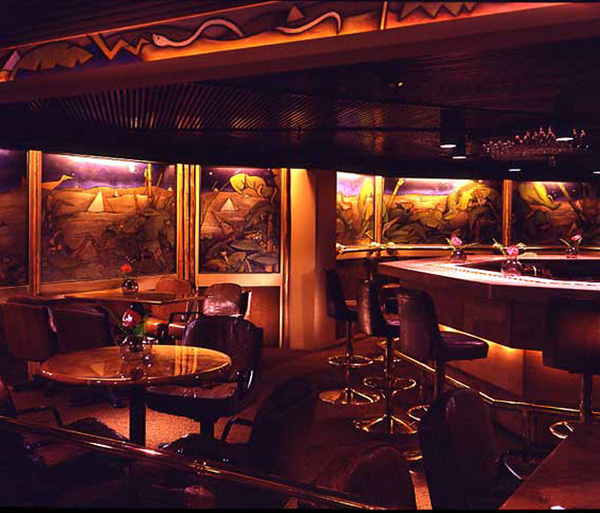
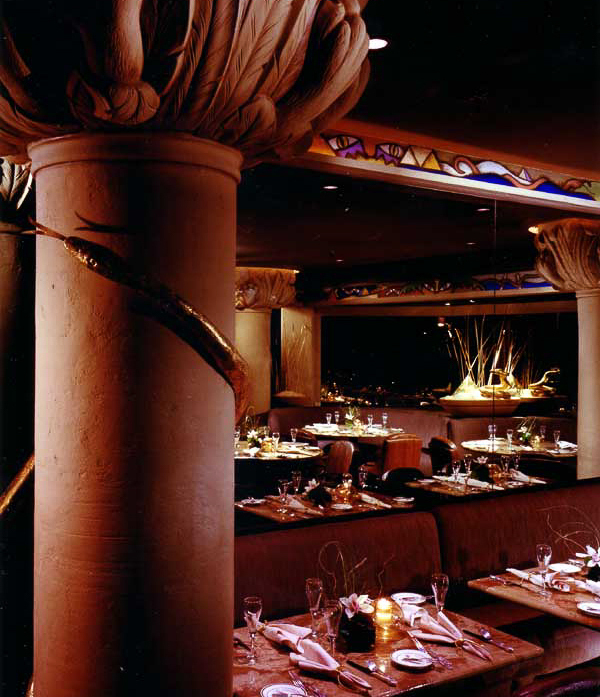
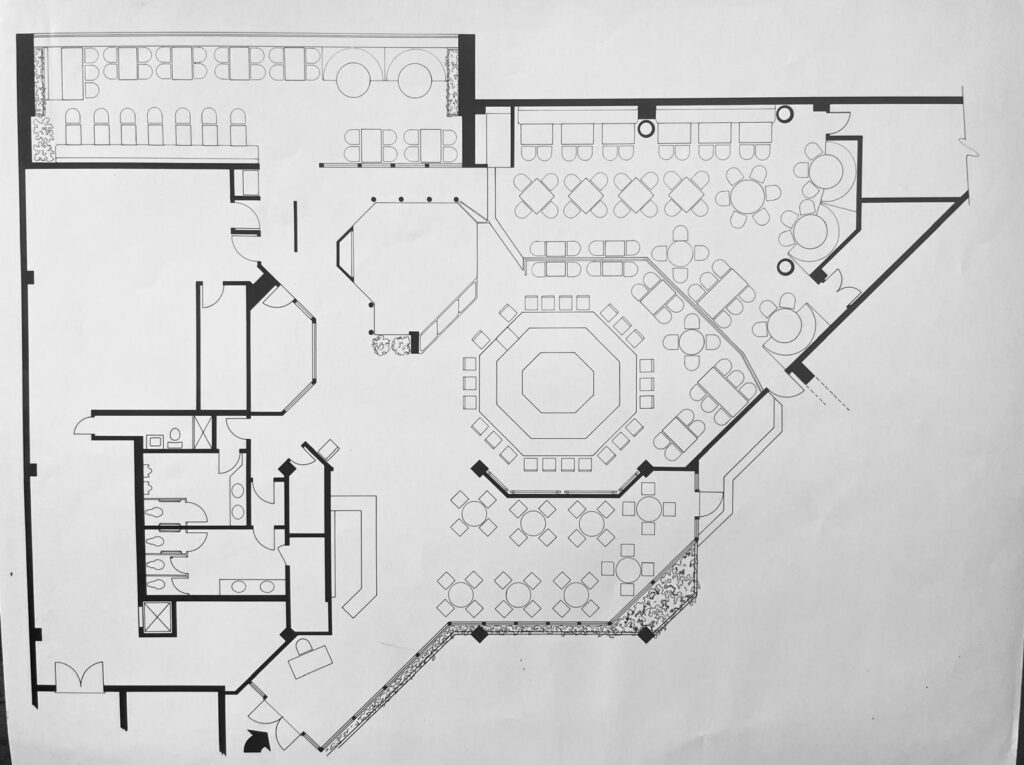
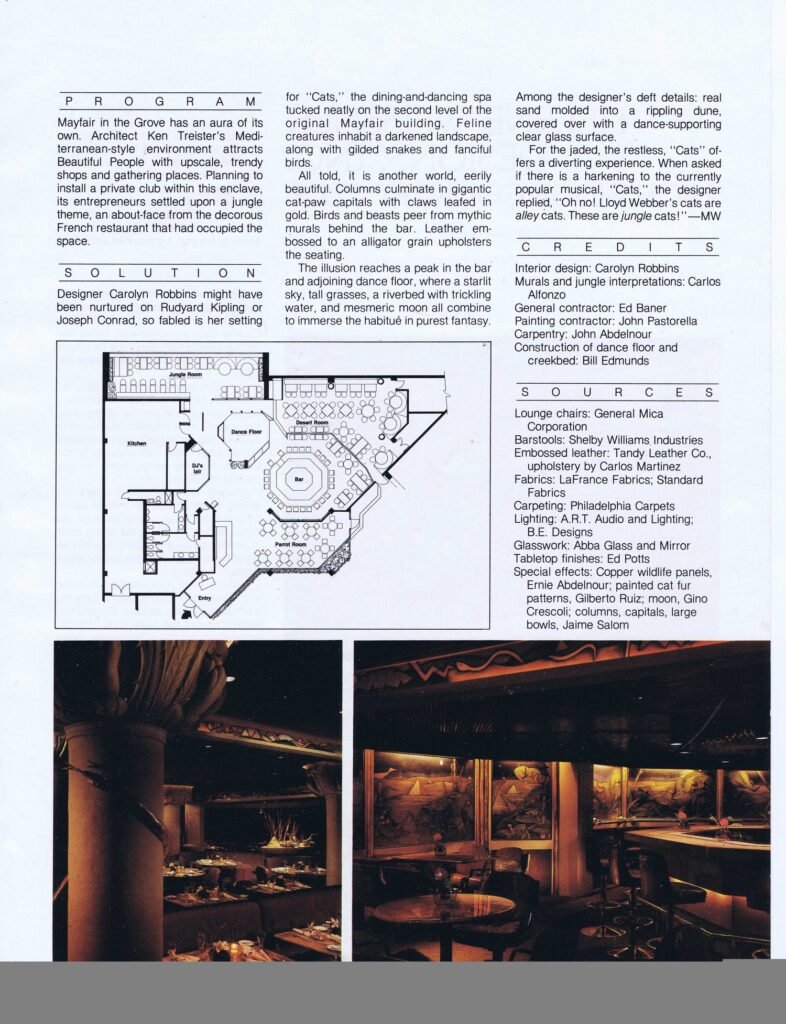
Guests first entered through a dramatic bar surrounded by murals of mischievous jungle cats hidden among oversized banana leaves, designed by the renowned artist, Carlos Alfonzo, who also surrounded the adjacent room with his illustrations. As a visitor moved deeper into the club, the lighting changed and the atmosphere transformed into a moonlit desert inspired by the Nile. Columns were designed with capitals resembling feline paws, while gold-leaf serpents wrapped around their bases.
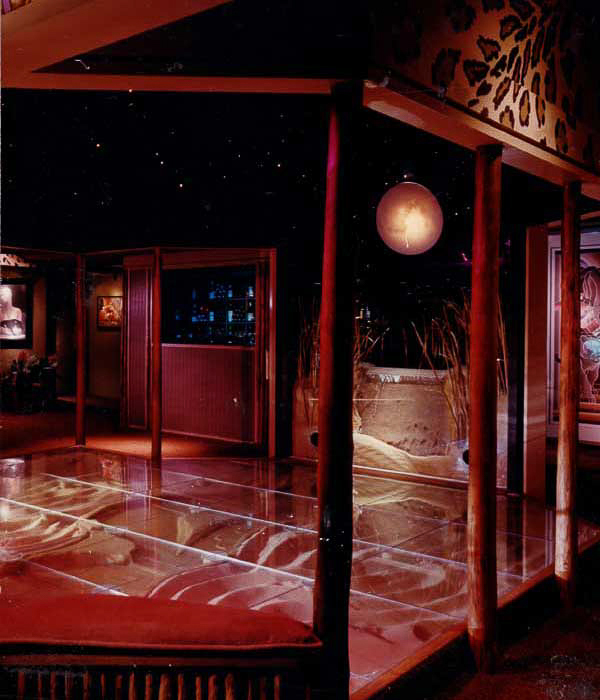
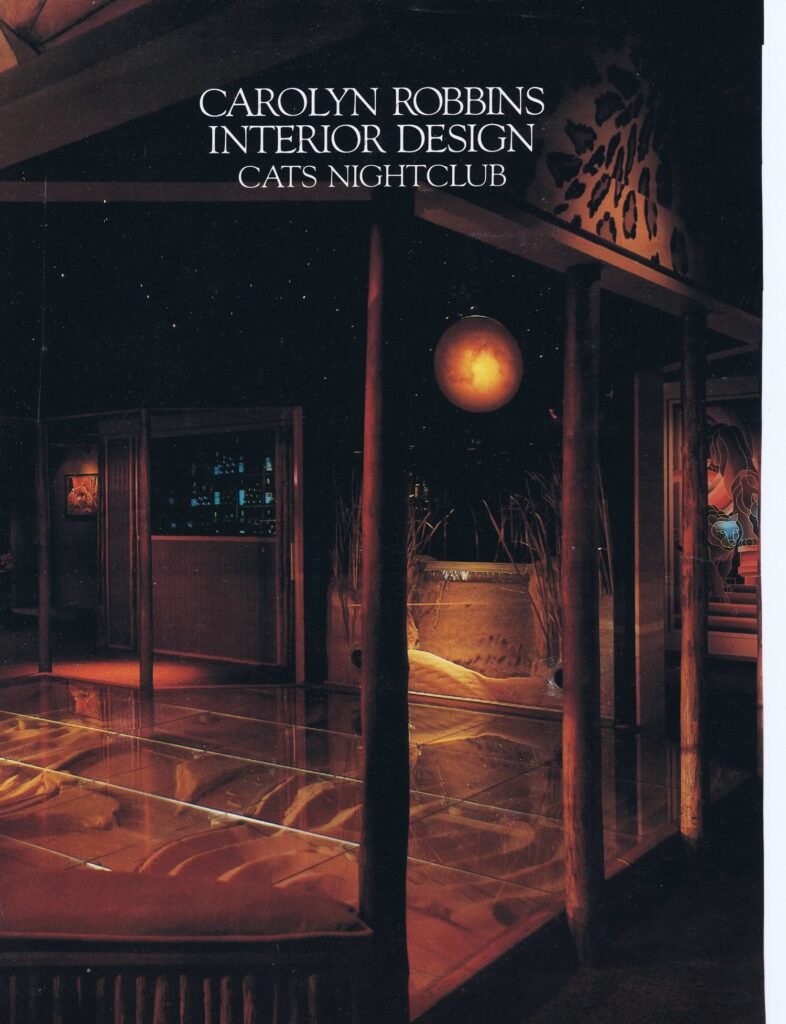
At the end of the elevated dance floor, a waterfall and rising moon appeared behind a wall of glass. The dance floor itself became part of the experience. Elevated on clear Lucite tubular supports, it appeared to float above a flowing river. Water moved beneath the dancers, creating the illusion that guests were dancing above a living landscape rather than simply standing on a floor.
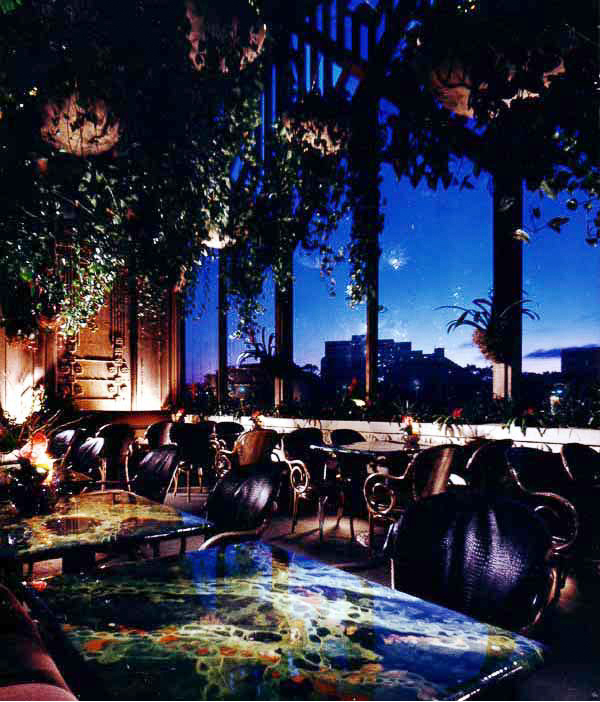
Above the dance floor, layers of black theatrical scrim were suspended overhead, with hundreds of tiny lights sewn into the mesh to create a remarkably realistic star-filled night sky. A garden room completed the experience with painted antler chairs, lush cascading vines and intimate seating areas integrated into Kenneth Treister’s beautifully textured architecture.
The client originally envisioned literal cat sculptures throughout the club, but I believed the concept was already present in the environment itself. The elegant waitresses, moving gracefully through these carefully designed settings, became the “cats.” The architecture, lighting and atmosphere carried the story without relying on obvious ‘cat type’ decoration.
What Made This Project Unique
What set Cat’s apart was its ability to transport guests into another world. During the height of Miami’s disco era, Cat’s took a different direction. It was a cinematic experience built around atmosphere, romance and imagination.
I wanted guests to feel as though they had stepped into another environment, to dance beneath a starlit sky, move above a flowing river, hear the sound of water and experience the mystery of a moon that changes throughout the evening. Every element, from the lighting and sound to the moving water and intimate spaces, was carefully orchestrated to create an emotional response.
I had learned from the private club and The Mutiny, that when people feel comfortable in their surroundings, and especially when the lighting makes them feel confident, they stay longer, relax and enjoy the evening. The carefully designed lighting became one of the most important ingredients of the experience.
Cat’s design proved hospitality design is not simply about how a space looks. It is about how a space makes people feel.
Photos by Dan Forer
Project Overview
Cat’s Nightclub was one of the defining projects of my early career. Monty Trainer, a respected Miami restaurateur, and Suzanne Johnson, a renowned nightclub manager, came together to develop a private membership nightclub within Kenneth Treister’s remarkable Mayfair development in Coconut Grove, Florida.
Having recently completed the interiors for the Mutiny Hotel across the street, I was invited to create an entertainment environment unlike anything else in Miami. Working alongside three influential figures in hospitality, nightlife and architecture was an extraordinary opportunity and a challenge that pushed me to explore design as a complete sensory experience.
The concept was to create more than a nightclub. Cat’s was envisioned as an immersive environment where architecture, lighting, sound and movement would transport guests into another world.
Design Story
Rather than creating a disco with mirrored balls and flashing strobe lights of that era, I imagined Cat’s as a series of cinematic environments inspired by the natural habitats of wild cats.
Guests first entered through a dramatic bar surrounded by murals of mischievous jungle cats hidden among oversized banana leaves, designed by the renowned artist, Carlos Alfonzo, who also surrounded the adjacent room with his illustrations. As a visitor moved deeper into the club, the lighting changed and the atmosphere transformed into a moonlit desert inspired by the Nile. Columns were designed with capitals resembling feline paws, while gold-leaf serpents wrapped around their bases.
At the end of the elevated dance floor, a waterfall and rising moon appeared behind a wall of glass. The dance floor itself became part of the experience. Elevated on clear Lucite tubular supports, it appeared to float above a flowing river. Water moved beneath the dancers, creating the illusion that guests were dancing above a living landscape rather than simply standing on a floor.
Above the dance floor, layers of black theatrical scrim were suspended overhead, with hundreds of tiny lights sewn into the mesh to create a remarkably realistic star-filled night sky. A garden room completed the experience with painted antler chairs, lush cascading vines and intimate seating areas integrated into Kenneth Treister’s beautifully textured architecture.
The client originally envisioned literal cat sculptures throughout the club, but I believed the concept was already present in the environment itself. The elegant waitresses, moving gracefully through these carefully designed settings, became the “cats.” The architecture, lighting and atmosphere carried the story without relying on obvious ‘cat type’ decoration.
What Made This Project Unique
What set Cat’s apart was its ability to transport guests into another world. During the height of Miami’s disco era, Cat’s took a different direction. It was a cinematic experience built around atmosphere, romance and imagination.
I wanted guests to feel as though they had stepped into another environment, to dance beneath a starlit sky, move above a flowing river, hear the sound of water and experience the mystery of a moon that changes throughout the evening. Every element, from the lighting and sound to the moving water and intimate spaces, was carefully orchestrated to create an emotional response.
I had learned from the private club and The Mutiny, that when people feel comfortable in their surroundings, and especially when the lighting makes them feel confident, they stay longer, relax and enjoy the evening. The carefully designed lighting became one of the most important ingredients of the experience.
Cat’s design proved hospitality design is not simply about how a space looks. It is about how a space makes people feel.
Photos by Dan Forer
Project Overview
Cat’s Nightclub was one of the defining projects of my early career. Monty Trainer, a respected Miami restaurateur, and Suzanne Johnson, a renowned nightclub manager, came together to develop a private membership nightclub within Kenneth Treister’s remarkable Mayfair development in Coconut Grove, Florida.
Having recently completed the interiors for the Mutiny Hotel across the street, I was invited to create an entertainment environment unlike anything else in Miami. Working alongside three influential figures in hospitality, nightlife and architecture was an extraordinary opportunity and a challenge that pushed me to explore design as a complete sensory experience.
The concept was to create more than a nightclub. Cat’s was envisioned as an immersive environment where architecture, lighting, sound and movement would transport guests into another world.
Design Story
Rather than creating a disco with mirrored balls and flashing strobe lights of that era, I imagined Cat’s as a series of cinematic environments inspired by the natural habitats of wild cats.
Guests first entered through a dramatic bar surrounded by murals of mischievous jungle cats hidden among oversized banana leaves, designed by the renowned artist, Carlos Alfonzo, who also surrounded the adjacent room with his illustrations. As a visitor moved deeper into the club, the lighting changed and the atmosphere transformed into a moonlit desert inspired by the Nile. Columns were designed with capitals resembling feline paws, while gold-leaf serpents wrapped around their bases.
At the end of the elevated dance floor, a waterfall and rising moon appeared behind a wall of glass. The dance floor itself became part of the experience. Elevated on clear Lucite tubular supports, it appeared to float above a flowing river. Water moved beneath the dancers, creating the illusion that guests were dancing above a living landscape rather than simply standing on a floor.
Above the dance floor, layers of black theatrical scrim were suspended overhead, with hundreds of tiny lights sewn into the mesh to create a remarkably realistic star-filled night sky. A garden room completed the experience with painted antler chairs, lush cascading vines and intimate seating areas integrated into Kenneth Treister’s beautifully textured architecture.
The client originally envisioned literal cat sculptures throughout the club, but I believed the concept was already present in the environment itself. The elegant waitresses, moving gracefully through these carefully designed settings, became the “cats.” The architecture, lighting and atmosphere carried the story without relying on obvious ‘cat type’ decoration.
What Made This Project Unique
What set Cat’s apart was its ability to transport guests into another world. During the height of Miami’s disco era, Cat’s took a different direction. It was a cinematic experience built around atmosphere, romance and imagination.
I wanted guests to feel as though they had stepped into another environment, to dance beneath a starlit sky, move above a flowing river, hear the sound of water and experience the mystery of a moon that changes throughout the evening. Every element, from the lighting and sound to the moving water and intimate spaces, was carefully orchestrated to create an emotional response.
I had learned from the private club and The Mutiny, that when people feel comfortable in their surroundings, and especially when the lighting makes them feel confident, they stay longer, relax and enjoy the evening. The carefully designed lighting became one of the most important ingredients of the experience.
Cat’s design proved hospitality design is not simply about how a space looks. It is about how a space makes people feel.
Photos by Dan Forer
Project Overview
Cat’s Nightclub was one of the defining projects of my early career. Monty Trainer, a respected Miami restaurateur, and Suzanne Johnson, a renowned nightclub manager, came together to develop a private membership nightclub within Kenneth Treister’s remarkable Mayfair development in Coconut Grove, Florida.
Having recently completed the interiors for the Mutiny Hotel across the street, I was invited to create an entertainment environment unlike anything else in Miami. Working alongside three influential figures in hospitality, nightlife and architecture was an extraordinary opportunity and a challenge that pushed me to explore design as a complete sensory experience.
The concept was to create more than a nightclub. Cat’s was envisioned as an immersive environment where architecture, lighting, sound and movement would transport guests into another world.
Design Story
Rather than creating a disco with mirrored balls and flashing strobe lights of that era, I imagined Cat’s as a series of cinematic environments inspired by the natural habitats of wild cats.
Guests first entered through a dramatic bar surrounded by murals of mischievous jungle cats hidden among oversized banana leaves, designed by the renowned artist, Carlos Alfonzo, who also surrounded the adjacent room with his illustrations. As a visitor moved deeper into the club, the lighting changed and the atmosphere transformed into a moonlit desert inspired by the Nile. Columns were designed with capitals resembling feline paws, while gold-leaf serpents wrapped around their bases.
At the end of the elevated dance floor, a waterfall and rising moon appeared behind a wall of glass. The dance floor itself became part of the experience. Elevated on clear Lucite tubular supports, it appeared to float above a flowing river. Water moved beneath the dancers, creating the illusion that guests were dancing above a living landscape rather than simply standing on a floor.
Above the dance floor, layers of black theatrical scrim were suspended overhead, with hundreds of tiny lights sewn into the mesh to create a remarkably realistic star-filled night sky. A garden room completed the experience with painted antler chairs, lush cascading vines and intimate seating areas integrated into Kenneth Treister’s beautifully textured architecture.
The client originally envisioned literal cat sculptures throughout the club, but I believed the concept was already present in the environment itself. The elegant waitresses, moving gracefully through these carefully designed settings, became the “cats.” The architecture, lighting and atmosphere carried the story without relying on obvious ‘cat type’ decoration.
What Made This Project Unique
What set Cat’s apart was its ability to transport guests into another world. During the height of Miami’s disco era, Cat’s took a different direction. It was a cinematic experience built around atmosphere, romance and imagination.
I wanted guests to feel as though they had stepped into another environment, to dance beneath a starlit sky, move above a flowing river, hear the sound of water and experience the mystery of a moon that changes throughout the evening. Every element, from the lighting and sound to the moving water and intimate spaces, was carefully orchestrated to create an emotional response.
I had learned from the private club and The Mutiny, that when people feel comfortable in their surroundings, and especially when the lighting makes them feel confident, they stay longer, relax and enjoy the evening. The carefully designed lighting became one of the most important ingredients of the experience.
Cat’s design proved hospitality design is not simply about how a space looks. It is about how a space makes people feel.
Photos by Dan Forer
Project Overview
Cat’s Nightclub was one of the defining projects of my early career. Monty Trainer, a respected Miami restaurateur, and Suzanne Johnson, a renowned nightclub manager, came together to develop a private membership nightclub within Kenneth Treister’s remarkable Mayfair development in Coconut Grove, Florida.
Having recently completed the interiors for the Mutiny Hotel across the street, I was invited to create an entertainment environment unlike anything else in Miami. Working alongside three influential figures in hospitality, nightlife and architecture was an extraordinary opportunity and a challenge that pushed me to explore design as a complete sensory experience.
The concept was to create more than a nightclub. Cat’s was envisioned as an immersive environment where architecture, lighting, sound and movement would transport guests into another world.
Design Story
Rather than creating a disco with mirrored balls and flashing strobe lights of that era, I imagined Cat’s as a series of cinematic environments inspired by the natural habitats of wild cats.
Guests first entered through a dramatic bar surrounded by murals of mischievous jungle cats hidden among oversized banana leaves, designed by the renowned artist, Carlos Alfonzo, who also surrounded the adjacent room with his illustrations. As a visitor moved deeper into the club, the lighting changed and the atmosphere transformed into a moonlit desert inspired by the Nile. Columns were designed with capitals resembling feline paws, while gold-leaf serpents wrapped around their bases.
At the end of the elevated dance floor, a waterfall and rising moon appeared behind a wall of glass. The dance floor itself became part of the experience. Elevated on clear Lucite tubular supports, it appeared to float above a flowing river. Water moved beneath the dancers, creating the illusion that guests were dancing above a living landscape rather than simply standing on a floor.
Above the dance floor, layers of black theatrical scrim were suspended overhead, with hundreds of tiny lights sewn into the mesh to create a remarkably realistic star-filled night sky. A garden room completed the experience with painted antler chairs, lush cascading vines and intimate seating areas integrated into Kenneth Treister’s beautifully textured architecture.
The client originally envisioned literal cat sculptures throughout the club, but I believed the concept was already present in the environment itself. The elegant waitresses, moving gracefully through these carefully designed settings, became the “cats.” The architecture, lighting and atmosphere carried the story without relying on obvious ‘cat type’ decoration.
What Made This Project Unique
What set Cat’s apart was its ability to transport guests into another world. During the height of Miami’s disco era, Cat’s took a different direction. It was a cinematic experience built around atmosphere, romance and imagination.
I wanted guests to feel as though they had stepped into another environment, to dance beneath a starlit sky, move above a flowing river, hear the sound of water and experience the mystery of a moon that changes throughout the evening. Every element, from the lighting and sound to the moving water and intimate spaces, was carefully orchestrated to create an emotional response.
I had learned from the private club and The Mutiny, that when people feel comfortable in their surroundings, and especially when the lighting makes them feel confident, they stay longer, relax and enjoy the evening. The carefully designed lighting became one of the most important ingredients of the experience.
Cat’s design proved hospitality design is not simply about how a space looks. It is about how a space makes people feel.
Photos by Dan Forer
Project Overview
Cat’s Nightclub was one of the defining projects of my early career. Monty Trainer, a respected Miami restaurateur, and Suzanne Johnson, a renowned nightclub manager, came together to develop a private membership nightclub within Kenneth Treister’s remarkable Mayfair development in Coconut Grove, Florida.
Having recently completed the interiors for the Mutiny Hotel across the street, I was invited to create an entertainment environment unlike anything else in Miami. Working alongside three influential figures in hospitality, nightlife and architecture was an extraordinary opportunity and a challenge that pushed me to explore design as a complete sensory experience.
The concept was to create more than a nightclub. Cat’s was envisioned as an immersive environment where architecture, lighting, sound and movement would transport guests into another world.
Design Story
Rather than creating a disco with mirrored balls and flashing strobe lights of that era, I imagined Cat’s as a series of cinematic environments inspired by the natural habitats of wild cats.
Guests first entered through a dramatic bar surrounded by murals of mischievous jungle cats hidden among oversized banana leaves, designed by the renowned artist, Carlos Alfonzo, who also surrounded the adjacent room with his illustrations. As a visitor moved deeper into the club, the lighting changed and the atmosphere transformed into a moonlit desert inspired by the Nile. Columns were designed with capitals resembling feline paws, while gold-leaf serpents wrapped around their bases.
At the end of the elevated dance floor, a waterfall and rising moon appeared behind a wall of glass. The dance floor itself became part of the experience. Elevated on clear Lucite tubular supports, it appeared to float above a flowing river. Water moved beneath the dancers, creating the illusion that guests were dancing above a living landscape rather than simply standing on a floor.
Above the dance floor, layers of black theatrical scrim were suspended overhead, with hundreds of tiny lights sewn into the mesh to create a remarkably realistic star-filled night sky. A garden room completed the experience with painted antler chairs, lush cascading vines and intimate seating areas integrated into Kenneth Treister’s beautifully textured architecture.
The client originally envisioned literal cat sculptures throughout the club, but I believed the concept was already present in the environment itself. The elegant waitresses, moving gracefully through these carefully designed settings, became the “cats.” The architecture, lighting and atmosphere carried the story without relying on obvious ‘cat type’ decoration.
What Made This Project Unique
What set Cat’s apart was its ability to transport guests into another world. During the height of Miami’s disco era, Cat’s took a different direction. It was a cinematic experience built around atmosphere, romance and imagination.
I wanted guests to feel as though they had stepped into another environment, to dance beneath a starlit sky, move above a flowing river, hear the sound of water and experience the mystery of a moon that changes throughout the evening. Every element, from the lighting and sound to the moving water and intimate spaces, was carefully orchestrated to create an emotional response.
I had learned from the private club and The Mutiny, that when people feel comfortable in their surroundings, and especially when the lighting makes them feel confident, they stay longer, relax and enjoy the evening. The carefully designed lighting became one of the most important ingredients of the experience.
Cat’s design proved hospitality design is not simply about how a space looks. It is about how a space makes people feel.
Photos by Dan Forer
Project Overview
Cat’s Nightclub was one of the defining projects of my early career. Monty Trainer, a respected Miami restaurateur, and Suzanne Johnson, a renowned nightclub manager, came together to develop a private membership nightclub within Kenneth Treister’s remarkable Mayfair development in Coconut Grove, Florida.
Having recently completed the interiors for the Mutiny Hotel across the street, I was invited to create an entertainment environment unlike anything else in Miami. Working alongside three influential figures in hospitality, nightlife and architecture was an extraordinary opportunity and a challenge that pushed me to explore design as a complete sensory experience.
The concept was to create more than a nightclub. Cat’s was envisioned as an immersive environment where architecture, lighting, sound and movement would transport guests into another world.
Design Story
Rather than creating a disco with mirrored balls and flashing strobe lights of that era, I imagined Cat’s as a series of cinematic environments inspired by the natural habitats of wild cats.
Guests first entered through a dramatic bar surrounded by murals of mischievous jungle cats hidden among oversized banana leaves, designed by the renowned artist, Carlos Alfonzo, who also surrounded the adjacent room with his illustrations. As a visitor moved deeper into the club, the lighting changed and the atmosphere transformed into a moonlit desert inspired by the Nile. Columns were designed with capitals resembling feline paws, while gold-leaf serpents wrapped around their bases.
At the end of the elevated dance floor, a waterfall and rising moon appeared behind a wall of glass. The dance floor itself became part of the experience. Elevated on clear Lucite tubular supports, it appeared to float above a flowing river. Water moved beneath the dancers, creating the illusion that guests were dancing above a living landscape rather than simply standing on a floor.
Above the dance floor, layers of black theatrical scrim were suspended overhead, with hundreds of tiny lights sewn into the mesh to create a remarkably realistic star-filled night sky. A garden room completed the experience with painted antler chairs, lush cascading vines and intimate seating areas integrated into Kenneth Treister’s beautifully textured architecture.
The client originally envisioned literal cat sculptures throughout the club, but I believed the concept was already present in the environment itself. The elegant waitresses, moving gracefully through these carefully designed settings, became the “cats.” The architecture, lighting and atmosphere carried the story without relying on obvious ‘cat type’ decoration.
What Made This Project Unique
What set Cat’s apart was its ability to transport guests into another world. During the height of Miami’s disco era, Cat’s took a different direction. It was a cinematic experience built around atmosphere, romance and imagination.
I wanted guests to feel as though they had stepped into another environment, to dance beneath a starlit sky, move above a flowing river, hear the sound of water and experience the mystery of a moon that changes throughout the evening. Every element, from the lighting and sound to the moving water and intimate spaces, was carefully orchestrated to create an emotional response.
I had learned from the private club and The Mutiny, that when people feel comfortable in their surroundings, and especially when the lighting makes them feel confident, they stay longer, relax and enjoy the evening. The carefully designed lighting became one of the most important ingredients of the experience.
Cat’s design proved hospitality design is not simply about how a space looks. It is about how a space makes people feel.
Photos by Dan Forer
Project Overview
Cat’s Nightclub was one of the defining projects of my early career. Monty Trainer, a respected Miami restaurateur, and Suzanne Johnson, a renowned nightclub manager, came together to develop a private membership nightclub within Kenneth Treister’s remarkable Mayfair development in Coconut Grove, Florida.
Having recently completed the interiors for the Mutiny Hotel across the street, I was invited to create an entertainment environment unlike anything else in Miami. Working alongside three influential figures in hospitality, nightlife and architecture was an extraordinary opportunity and a challenge that pushed me to explore design as a complete sensory experience.
The concept was to create more than a nightclub. Cat’s was envisioned as an immersive environment where architecture, lighting, sound and movement would transport guests into another world.
Design Story
Rather than creating a disco with mirrored balls and flashing strobe lights of that era, I imagined Cat’s as a series of cinematic environments inspired by the natural habitats of wild cats.
Guests first entered through a dramatic bar surrounded by murals of mischievous jungle cats hidden among oversized banana leaves, designed by the renowned artist, Carlos Alfonzo, who also surrounded the adjacent room with his illustrations. As a visitor moved deeper into the club, the lighting changed and the atmosphere transformed into a moonlit desert inspired by the Nile. Columns were designed with capitals resembling feline paws, while gold-leaf serpents wrapped around their bases.
At the end of the elevated dance floor, a waterfall and rising moon appeared behind a wall of glass. The dance floor itself became part of the experience. Elevated on clear Lucite tubular supports, it appeared to float above a flowing river. Water moved beneath the dancers, creating the illusion that guests were dancing above a living landscape rather than simply standing on a floor.
Above the dance floor, layers of black theatrical scrim were suspended overhead, with hundreds of tiny lights sewn into the mesh to create a remarkably realistic star-filled night sky. A garden room completed the experience with painted antler chairs, lush cascading vines and intimate seating areas integrated into Kenneth Treister’s beautifully textured architecture.
The client originally envisioned literal cat sculptures throughout the club, but I believed the concept was already present in the environment itself. The elegant waitresses, moving gracefully through these carefully designed settings, became the “cats.” The architecture, lighting and atmosphere carried the story without relying on obvious ‘cat type’ decoration.
What Made This Project Unique
What set Cat’s apart was its ability to transport guests into another world. During the height of Miami’s disco era, Cat’s took a different direction. It was a cinematic experience built around atmosphere, romance and imagination.
I wanted guests to feel as though they had stepped into another environment, to dance beneath a starlit sky, move above a flowing river, hear the sound of water and experience the mystery of a moon that changes throughout the evening. Every element, from the lighting and sound to the moving water and intimate spaces, was carefully orchestrated to create an emotional response.
I had learned from the private club and The Mutiny, that when people feel comfortable in their surroundings, and especially when the lighting makes them feel confident, they stay longer, relax and enjoy the evening. The carefully designed lighting became one of the most important ingredients of the experience.
Cat’s design proved hospitality design is not simply about how a space looks. It is about how a space makes people feel.
Photos by Dan Forer